Tuesday, December 8, 2009

Streetwise


After watching Streetwise, I seemed to be totally taken aback by the extreme poverty in our nation. Juxtaposing the images of the intensely depraved children with Seattle ("The most livable city in America), really allowed for Martin Bell's argument be solidified. It was actually frightening to me to see such potentially similar people in such grave states. It was sad to see that America has inevitably allowed this to occur, or so Bell argues.
With using such a unique character as Tiny, Bell is able to make a powerful statement about America in general. It is that parents are the most direct influences of their child's future, so they MUST begin to act accordingly. Tiny's alcoholic mother sees her prostitution as a "phase" and emotionally neglects her for many years. All of these things have undoubtedly negatively influenced Tiny, leading to her pitiful life now. If only her mother would have actually showed some emotional and physical support towards Tiny....one can only guess the extent of how this would have positively benefited this poor girl.

Sicko


Moore does it once again...and I LOVED it once again. Moore's legitimacy just seems to build with every project and that is completely evident in this film. His points are valid, yet many Americans seemed opposed to him. It is because they genuinely do not believe what he is saying, or is it because Moore's statements are so painfully true that no one wants to believe him. Yet the facts just cannot lie and this is what is so appealing about Moore. He is able to craft his argument is such a way that it is extremely truthful to the viewer, yet the difficult to comprehend because of its underlying meaning. For example, America's health care program is in total shambles, yet many still maintain the beliefs that nothing can be done about this problem. So is it that we cannot do anything, or are just to lazy to really stand up and fight for basic, civil rights.
Moore's intricate use of comparing other country's medical programs to America's health care, really makes his argument take hold. All Americans, whether we like to think it or not, believe that they undoubtedly live in the best nation ever. Moore is not arguing this, but instead is making the point that if this is true, then shouldn't our most basic health care reflect this. Americans should expect only the best from our physicians and drug companies, and therefore should demand some sort of change in the current health care system.

The Unforseen....or was it?


I was totally captured while first viewing the film, The Unforseen. Although I have been coming to Austin since the early 1990's (older sister at UT-Austin), I was actually shocked to find out that there is so much discontent with the ways Austin is being built up. To be perfectly honest, I can't see how much would be different if Austin and its residents wish to be such a popular, growing city. The natural progression of man is to build bigger and better things, which is totally evident in Austin's increased real estate.
It is slightly shocking that this plan could potentially harm one of the city's most well-known and most beloved attractions though. Yet the overall land-development in Austin has perhaps gone too quickly, there has been much gained in these developments. A good deal amount more of money is coming into Austin with it's increased population and an ample amount of jobs were created. Although the physical-aesthetics of the downtown Austin area might be lost, but what Austin has gained back is so much more.

Hearts & Minds


After first watching
Hearts and Minds I was totally shocked! The extreme inhumanness of the entire Vietnam war was just very difficult to watch for me, or anyone really it seems. Although I was well aware that many brutal, untold acts are performed in war, the degree that the American soldiers took this to was astounding. Killing someone alone is difficult but these soldiers obviously went to far. The main argument in this film is how inhumane Americans were during such a radical time in our history, but perhaps the underlying message is that Americans unknowingly look down upon every other minority country. Peter Davis, the director, purposefully using formal and informal shots to craft his argument and make it appear as credible. With some many radical, anti-Vietnam "hippies', Davis had to make sure that he appeared as legitimate as possible to really get his message to mainstream America.
Hands down, the most intense seen for me was watching the AVN soldier's burial with his wife and family bitterly mourning his death. Davis juxtaposes this with General Westmoreland's stating that "he Oriental doesn't put the same high price on life as does a Westerner. Life is plentiful. Life is cheap in the Orient". This was so frustrating to me as a viewer. How could he say such a completely false statement with such large implications like this?! Not only was is false, but it was extremely cruel to think that this idea is even possible. I did realize how vital this was for the film. Davis's techniques really place a ton of the light on the subjects, taking away from his own. This is what really allows for his credibility as a documentarian to take hold.

Sunday, November 1, 2009

Apple's Image

Many Americans have seen this famous ad and can easily identify it as for Apple. This has a lot to do with the pure genius in this advertising campaign. The faceless, all-black person allows for all types of viewers to immediately connect because all can see themselves as this person with no identity. The actual position that the person is in conveys to the audience that the person is dancing at the moment the image was created. This allows for the emotional connection that can be made with such an image because it seems as though this caricature is actually a real person. The all-black face also adds to the curiosity factor in this ad, beyond the more obvious new iPod which is trying to be sold by Apple. The vivid colors also make it really "pop" out to the viewers, increasing the attractiveness in the advertisement.
Apple, at the time this image was originally created, had been known for being the long-time underdog of Microsoft. This new and bright image makes the viewer rethink their previous notions about Apple and can create a totally new perception of the brand. Perhaps Apple was trying to really reach a totally new category of their consumers by these hip and stylish ads. The iPod's introduction to mainstream America also allows for these new ideas to be formed about Apple. The image is as much for bettering the perception of the Apple brand, as it it for introducing the revolutionary new product.

Kobe "Black Mamba" Bryant

Although I am an avid Kobe fan, the power in this image is undeniable. The image is of Kobe Bryant dunking a basketball with one hand. Perhaps the argument in displaying such an image is to show that Kobe is the best player in the NBA.The one-handed dunk alone is quite an impressive feat and the photograph displays this quite correctly. His passion and determination is captured in his face and the totally stretched-out body. Kobe being totally alone in the shot makes it seem as though he just can gotten a break-away or steal in a actual NBA game. The photograph allows for the viewer to feel as though they are actually seeing such a defiant play taking place right in front of them.
The little things in the image really allow for it to make such a strong statement to the viewers. Magic Johnson is in the background, standing up among the Laker's players and coaches. This could be indirectly showing how even Magic Johnson (10 NBA titles with the Lakers) must now realize how valuable and undeniable Kobe's talent is. The tiny NBA logo on the bottom, also adds to the credibility of the photograph, showing that this image was chosen for a reason. The reason being Kobe Bryant is the most dominating player in the NBA. Finally, his stern facial expression also just adds to the overall statement in the photo. It is that Kobe Bryant is determined to be the best and is rightfully so.

Wednesday, October 21, 2009

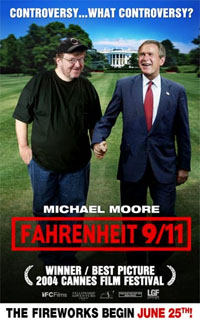
Farenheit 9/11


I feel as though that I am one of the few people that actually enjoyed Farenheit 9/11, It was entirely provocative and extremely entertaining. Yes...Moore is
undoubtedly an extreme liberal, but many of this arguments are well well-crafted and quite logical.
The hard truth is that every single actual fact in his films is totally true, such as when implying that the the Bush administration
gave Iraq money for many weapons, with many actually now being used upon America in this fight. Moore is attempting
to totally dislodge President Bush's crebibily and make America realize the stupidity of choosing such a corrupt and mislead
administration. Moore wants America to rid itself of such a problem, through voting for someone else in the upcoming 2004 election.
When the film was released it was an election year (2004) and Moore used this to his advantage. While discrediting the Bush
administration, he was also subliminally encouraging Americans to go and fix their problem through voting
for a new President. Moore realized how crucial is was for people to go out and actually change the problem, and also
that the Presidential elections are the biggest and best way to actually change America for the better.


An Inconvenient Truth


I absolutely loved this documentary! I feel as though Gore went about discussing such a controversial topic in the most appropriate way possible. His use of statistical and scientific information show how credible and legitimate Gore is in presenting the facts. He also continuously using minor comedy throughout the film to lighten the mood, yet does so in a way that does not lessen the validity of his argument. His side-segments about his life in politics and his life in general really help to drive Gore's central message home. How he relates his son's accident to the environmental cause was extremely effective in emotionally showing how relevant this issue is to all people.
Gore is weary of skeptics and therefore uses undeniable, scientific facts to increase his credibility as well as the legitimacy of the documentary. Many viewers can find these graphs and stats all very boring but this really was the best way for Gore to get his message across. He is weary of being seen as a pushy-environmentalist because this would really take away from the credibility of the movie. Gore doesn't necessarily care about the view of himself, as it is more about not taking away from the movie's important message.

Tuesday, September 22, 2009

Sontag Blog


Susan Sontag's "America, Seen Through Photographs, Darkly" seems to depict a small snippet of photograghy's history, especially in regards to "Whitmanesque" (105) photograghs. Yet, the article seems to really be about Diane Arbus and how her pictures, depicted something deep within herself but also displayed many similar feelings of many Americans at that times. It comes off as though Arbus' rich and privileged life really led to some sort of a revolt within herself, that led to her "Turn against what was public, conventional, safe and reassuring-and boring- in favor of what was private, hidden, ugly, dangerous, and fascinating" (113). She, along with many other Americans, felt as though her life thus far had been protected by her well-off, white family and that it was her time to really look at the world as it is. This ties back to her style of "Whitmanesque" pictures which depict everyone equal because of the fact that everyone is constantly changing. She now looked upon the ugly and grotesque as exciting and rare because of her sheltered childhood.

Also, Sontag makes it quite obvious that Arbus purposely chooses her strange characters and her settings in such a way that it draws in the viewer. The fact that she uses such alien people for her photographs but places them in such a light where there miserable lives are hard to be seen, causes the viewer to be slightly puzzled and therefore more curious. The picture above illustrates this perfectly in that such an unusual person seems to be surprisingly joyful, yet many Americans would think this little-person would be displaying a sorrowful gaze. It is clear at the end of the article that Sontag seems to be totally pro-Arbus' unique photography style and can appear that she wishes more artists were "against-the-norm" like Diane Arbus.